


A safety investigation of the big utes that haunt our roads has found that advanced crash avoidance technologies might help in reducing the menacing threat they pose to bike riders and pedestrians.
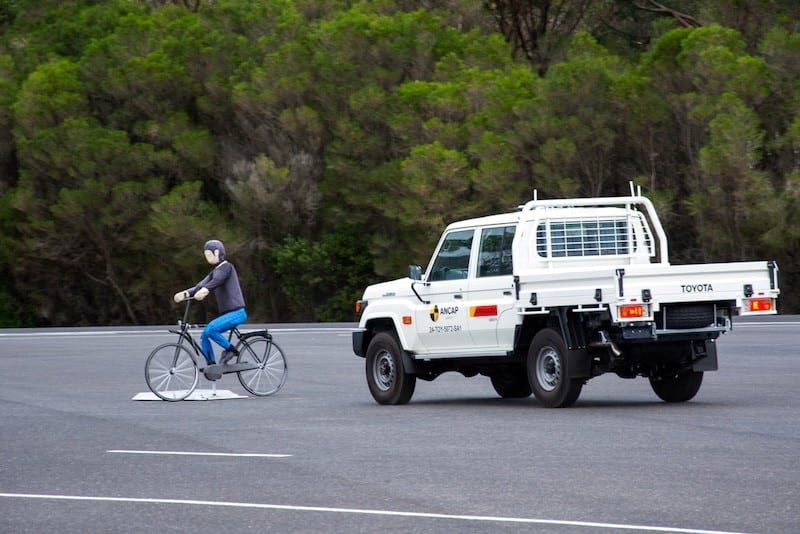
ANCAP Safety, the organisation that tests and rates cars sold in Australia for their safety equipment and performance, has recently tested a sample of these fashionable but obese beasts.
Some models have been fitted with advanced driver assistance systems that could possibly help drivers detect bike riders and pedestrians on the road and trigger emergency braking to avoid potential collisions.
There has been mounting concern among the road safety community over the impact that such large and heavy vehicles are having on the safety of our streets.
Vision of the zone immediately around the driver of these vehicles is poor. And because of their bulk they also impede the vision of other road users, increasing crash risks.
Research from around the world where these vehicles have rapidly become popular, especially in the United States, has shown that they are particularly hazardous to the vulnerable bodies of people walking and riding because of the high, blunt vehicle front.
Upper body injuries are far more prevalent in collisions involving these vehicles than in crashes with cars and utes with smaller and lower frontal areas.
ANCAP recently conducted its inaugural Large Utilities Advanced Driver Assistance Systems (ADAS) Safety Comparison with the current Chevrolet Silverado 1500, RAM 1500, Toyota LandCruiser 79 Series and Toyota Tundra – and an updated version of the Ford F-150, all vehicles that will be on the market in 2026.
The results were mixed with some vehicles rating highly but others poorly.
Fitted with one of the most comprehensive ranges of active safety features among the large utilities assessed, the updated Ford F-150 achieved the highest score (81%) and a Platinum safety grading.
Next highest was the RAM 1500, also fitted with a broad range of well-performing features, and scoring 70% and a Gold safety grading.
The two Toyota models, LandCruiser 79 Series and Tundra, each achieved Silver with scores of 55% and 50% respectively.
The Chevrolet Silverado offers a narrower range of crash avoidance performance, resulting in a safety grading of Bronze (27%).
The Silverado is fitted with a camera-only Autonomous Emergency Braking (AEB) system that detects vehicles and pedestrians. It is not capable of detecting cyclists, and provides only limited detection of motorcyclists.
ANCAP says the absence of cyclist detection and more advanced speed or monitoring systems leaves "notable gaps" in its safety package.
Maybe ANCAP should introduce a “lead” rating for such vehicles?
ANCAP chief executive officer, Carla Hoorweg, said larger vehicles pose a bigger threat to other road users than passenger cars and the best way to reduce the potential risk of fatalities and serious injuries from large vehicles was to make sure they did the best possible job at avoiding a crash.
“This first-look comparison establishes a benchmark in safety for the large pickups cohort and provides a path forward for manufacturers of these vehicles in creating better outcomes for road users.
“There is community concern over the size of pickups when they are driving in suburban streets, around schools and in built-up areas.
“We have applied international best practice in safety testing to this segment to make sure there is an incentive for manufacturers to improve crash avoidance technology.
"ANCAP has set a high standard for this program – well above regulation – and these vehicles have proven themselves with a high degree of advanced safety technology on board.
“Performance did vary but these results show there is a strong base to build from, and clear opportunity to achieve the performance levels seen in passenger vehicles.
”These initial comparisons will be used to inform the development of a framework and roadmap for future testing and assessment, and additional safety information is expected to be available for a broader range of large pickup models/variants from 2026.
"Future phases could potentially extend into physical crash protection, ensuring the full picture of both crash avoidance and crash protection."
Bike riders would agree that advanced technologies that can detect bike riders on the road and trigger emergency braking to avoid collisions are a great safety feature on any motor vehicle.
But when you are riding, these hulking vehicles can make it feel like you are sharing the road with a shipping container on wheels.
They are too wide, too high and too long for most urban environments where the streets are humming with humans.
If you want to take your poodle to the dog groomer sell the Silverado and get a cargo bike.
Or become our friend and subscribe to receive our fortnightly newsletter.