Federal and state governments are consolidating their plans around new rules for e-bikes.
Following the decision by authorities last year to reintroduce the European standard for e-bikes on Australian roads, the Commonwealth has now amended the import rules for e-bikes by re-inserting EN15194:2017 into the definition of an e-bike in the Australian Design Rules.
The Department of Transport and Border Security uses this definition to decide if a product is an e-bike that can be imported into Australia.
Such an e-bike must meet all the requirements of EN15194:2017 including having a maximum continuous power of 250 watts, a maximum assisted speed of 25km/h, and a maximum throttled-controlled walk-mode speed of 6km/h.
Significantly, the standard now also contains an anti-tampering provision to prevent the power and speed limitations being altered by sellers or owners.
A retailer manufacturer or retailer cannot provide a code, controller setting, device app, mechanical device, throttle in a box or any other functionality for consumer modification.
Shipments may be rejected if e-bikes are identified as not complying with EN15194.
The government has also made it clear that the definition will adopt any new standards that supersede EN15294:2017.
Note that the current European standard has moved forward to EN15194:2017+A1, which includes a new and better battery-specific standard, EN50604.
The adoption of this standard has been delayed because of the decision last year by the New South Wales Government to unilaterally force brands in that state to comply with a different battery standard. The federal government has agreed to give these brands time to transition their supply chains into line with the new national standards.
Meanwhile in Victoria the Department of Transport and Planning has developed guidance on restrictions for converted e-bikes on trains and changes for electronic transport devices (ETDs) on the public transport network.
Converted e-bikes are not allowed on metropolitan or regional trains in Victoria or in ticketed areas. A converted e-bike is a standard pedal bike that has been modified to add a motor and battery.
Charging, turning on and riding ETDs including e-bikes and e-scooters is also banned on all forms of public transport, including at stations.
Standard e-bikes and regular pedal bikes may still be brought on board trains.
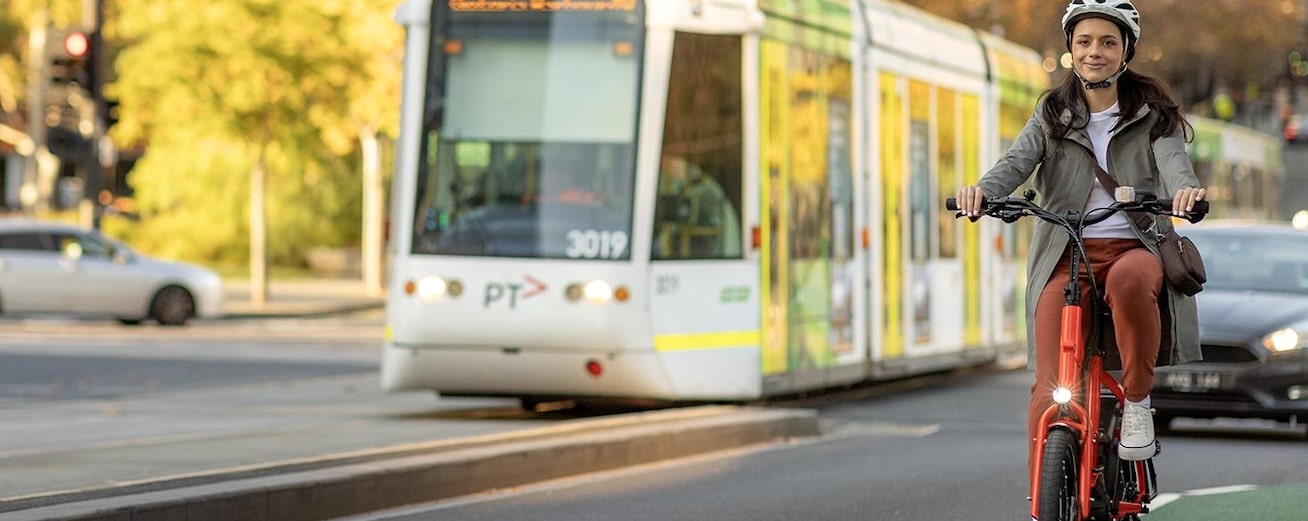
They may also be brought onto trams and buses if they can be folded.
There are no changes for passengers who use battery-powered mobility aids such as mobility scooters or electric wheelchairs.
The Department of Transport and Planning said that it would continue to monitor lithium-ion battery use and safety standards in relation to electronic transport devices and may introduce more changes in the future to ensure the public transport network remains safe.
Or become our friend and subscribe to receive our fortnightly newsletter.