

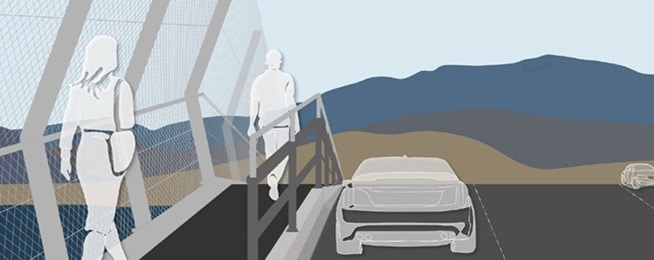
The state government is replacing the barriers on the Tasman Bridge paths and in the process will increase the number of passing bays on each side and remove the dangerous gantries.
The current barriers no longer meet safety standards and so will be replaced with a 3m high outer barrier and 1.2m high inner barrier.
The outer barrier will bulge outwards to provide more room for bicycle handlebars, which will be needed as riders will no longer be able to stick out over the inner barrier.
The current thick post outer barrier will be replaced by thinner posts and fine wire mesh. This will feel more open and less sturdy but the mesh is strong and is designed to hold in the case of impact.
The mesh and thinner posts should also improve sight-lines on the path, giving riders more stopping distance at the entries and exits where it can be difficult to see oncoming people until it's too late.
The large gantries that project into the path will be removed and new maintenance structures will be built into barriers so they don’t narrow the path width.
Path can’t be widened without significant problems
When designing the new barriers the government looked at whether the path could be widened and found that even though another 40cm could be added it would be difficult to build and would prevent timely maintenance on the underside of the bridge and the water mains.
The bridge is in its final decades of life and so will need more regular maintenance and the department decided it couldn’t risk delays and barriers to that happening when needed.
Instead, the barrier designers have come up with a way to provide three more passing bays on each side of the bridge, with each roughly 200–300 m apart.
Further consultation
The government had floated asking people about making the paths one-way but has decided to replace the barriers and see how that goes before going to consultation.
It will also accept feedback on the gap between the path edge and the path surface once the barriers have been replaced on the first path. The designers believe that bike riders won’t be able to ride so far over when the new barriers are in place, which should eliminate the problem of wheels getting stuck in the gap. However, if road bike riders are still finding it a problem the government will look at gap-filling solutions.
To replace the barriers one path will need to be closed for about 6 months and then the other for 6 months. All the work will take place at night so there won’t be any road closures during the day.
Design information
Bicycle Network has worked with a government stakeholder group to try and get the best outcomes for riders through the design process.
While we wanted to see a wider path, the engineering realities make this difficult to achieve if the bridge is going to be easily maintained and kept operating as one of Hobart’s most critical links.
The project is being released for tender with final design and construction to be confirmed, but the hope is work will begin in mid 2026.
More information on the designs and contact information for the project team is available at www.transport.tas.gov.au/roadworks/current_projects/south_road_projects/tasman_bridge_pathways_upgrade
Or become our friend and subscribe to receive our fortnightly newsletter.