

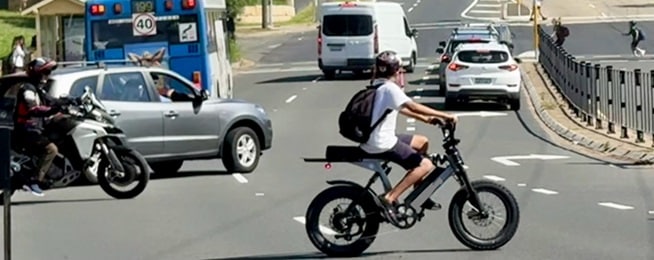
Bicycle Industries Australia, Tasmania Police and Bicycle Network teamed up during Bike Week to explain to MPs the problem of e-bikes on our roads that don’t meet the road rules and what’s needed to get rid of them.
Hosted by the Parliamentary Friends of Cycling group in the Tasmanian Parliament, the presentation gave MPs an idea of what’s happening in other states to tackle what are essentially unroadworthy motorbikes.
MP for Clarke and co-chair of the friends group, Helen Burnet, introduced the session, pointing out that we don’t want to deter people from riding legal e-bikes because of all their benefits.
Peter Bourke from BIA has been leading the charge to have the federal government fix the loophole in import controls that’s allowed so many bikes into the country that can’t be legally ridden on roads.
“Our biggest challenge is not e-bikes, its motorbikes masquerading as e-bikes,” he said.
Harmonising e-bike definition
“Loopholes have been created through import, through sales regulations and handballing the responsibility to the states to try and manage a problem which really should be controlled at a federal level.”
“In 2021 the federal government decided to streamline the importation process and in doing so they said it was up to the states to manage use more than it was up to them to control the product coming into the country so they withdraw the EN15194 standard (definition of an e-bike).”
“We’ve gone from one definition to now seven definitions of an e-bike across the country, the technical term we use to describe this is a ‘dog’s breakfast’.”
“What we’ve seen in the last two months is a reversal of the federal government position, on 17 December 2025, after a huge amount of lobbying including from the state transport ministers, it reinserted the EN15194 standard into the Road Vehicles Standards Act and Australian Design Rules.
Law lags behind reality
Tasmania Police’s Inspector Justin Lawson outlined the enforcement barriers the police are facing in confiscating bikes that are not legal on our roads.
Notably, that they don’t have the power to seize the bikes if the riders are not doing anything wrong, this contrasts with some other states where police are able to remove a vehicle that is not legal to ride on the road.
“The Police Offences Act allows us to intercept, seize a vehicle and/or clamp or confiscate it, those laws were in relation to motor cycles or motor cars. These types of vehicles have developed so quickly that the legislation has been left behind,” he said.
Police also won’t chase riders because of the risk involved.
“In a snapshot, you’ve got a 15-16 year old riding one of these things down Sandy Bay Road, I try to intercept him, he finds it frightening and puts the throttle down. If I try to engage in a chase or pursuit and he comes off the liability rests with me and over an incident that really doesn’t deserve a fatal or serious injury outcome.”
Inspector Lawson said police will use drones to follow riders but it depends on having that equipment available on the ground.
“We use it for stolen motor vehicles and any other use where we can minimise the risk to the rider, driver, police and members of the public, then that’s absolutely a win for us but there are just challenges of being there at the right time. “
Or become our friend and subscribe to receive our fortnightly newsletter.