


Update
At this week’s council meeting, the City of Yarra has voted for a second time to build narrow, sub-standard bike lanes along the strategic cycling corridor in Elizabeth Street, North Richmond.
Despite a report from the administration highlighting the risks of proceeding with the unorthodox concept, the council voted 6-2 in favour.
The temporary lanes now in place will remain while the city attempts to develop a detailed design that meets Mayor Stephen Jolly's requirements at the same time as it ignores standards such as lane width and sightlines.
Those plans then must be approved by the Department of Transport and Planning, which typically has high standards for safety.
In comments since devising the concept of narrow bike lanes Mr Jolly has justified the move as enabling him to provide additional car parking for visitors to the Vietnamese Buddhist temple in the street.
So far this year the decision-making on what should have been a straightforward adoption of established and standardised bike lane designs has been fumbled badly, embarrassing a city which was once a pioneering leader in the development of active travel infrastructure in Australia.
At their meeting in April the council adopted a suggestion from Mayor Stephen Jolly that the bike lanes in one section be just 1.5m wide.
Documents recently released following Freedom of Information requests indicate that key decisions on this matter were committed to by some councillors prior to, and without consideration of, advice and recommendations being provided by the council administration.
Tuesday council meeting was critical as the council meeting papers now released contain comprehensive details on several options for the bike lane designs, together with the implications of trying to reduce road safety in order to gain extra parking in a street where existing parking is underutilised.
Elizabeth Street is a designated Strategic Cycling Corridor, recognition of its future importance as a key route into Melbourne’s city centre from the inner east.
It connects to Albert Street through the City of Melbourne linking to other important north–south bike corridors through the inner city. Albert Street was one of Melbourne's earlier separated bike infrastructure streets, once controversial, but now accepted.
Furthermore, Elizabeth Street has had temporary separated bike lanes for an extended period since 2020 and evaluations have shown them to be successful with no negative outcomes for the surrounding neighbourhoods.
The officers' report to the council contains concept designs that respond to the council’s earlier request for narrowed lanes, but it also highlights the numerous pitfalls lying in wait for the ill-conceived proposal.
It includes a Road Safety Audit which draws attention to the fact that adding back car parking into the design would trigger multiple issues with sightline requirements, resulting in unsafe conditions for road users. In effect the council would have narrowed the bike lanes in order to put back car parking that they then have to take out again because of safety concerns.
There is also a substantial risk that the Department of Transport and Planning will determine that the proposal is unsatisfactory and ask for changes. Theoretically, the council could proceed without such approvals, but such a move would ring alarm bells in Spring Street.
And then there are the council's insurers, the MAV Liability Mutual Insurance scheme. This is a not-for-profit scheme comprising other Melbourne councils, including those who build their bike lanes to recognised standards so that they will not face the liability claims that the City of Yarra is now inviting with its non-compliant design proposal.
Bicycle Network, speaking from many years of experience in the planning, design and delivery of bike infrastructure, would never advise any road authority to build a separated lane this narrow.
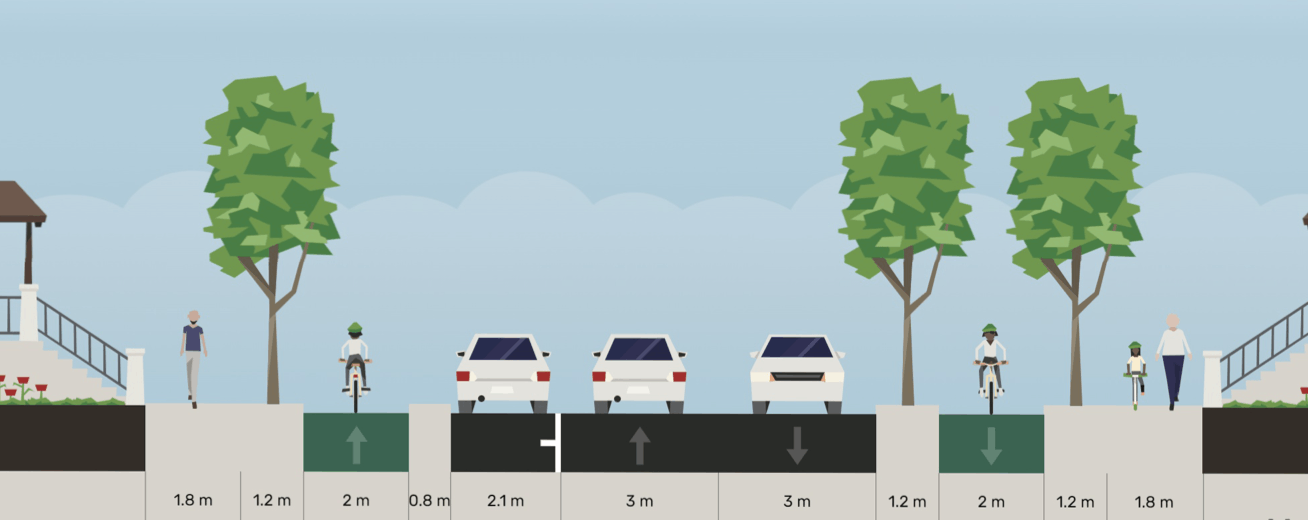
The rider has a gutter on their left which is not considered to be "rideable space”, so your 1.5m bike lane is not even that wide to begin with. And on the rider’s right is a barrier kerb which riders never ride close to because of risk of pedal strike, so the rideable area is narrowed again.
Victoria has several decades of experience with separated bike lanes and there is pretty much universal agreement that lanes should be 2m wide, with 1.8m the minimum acceptable.
Or become our friend and subscribe to receive our fortnightly newsletter.