

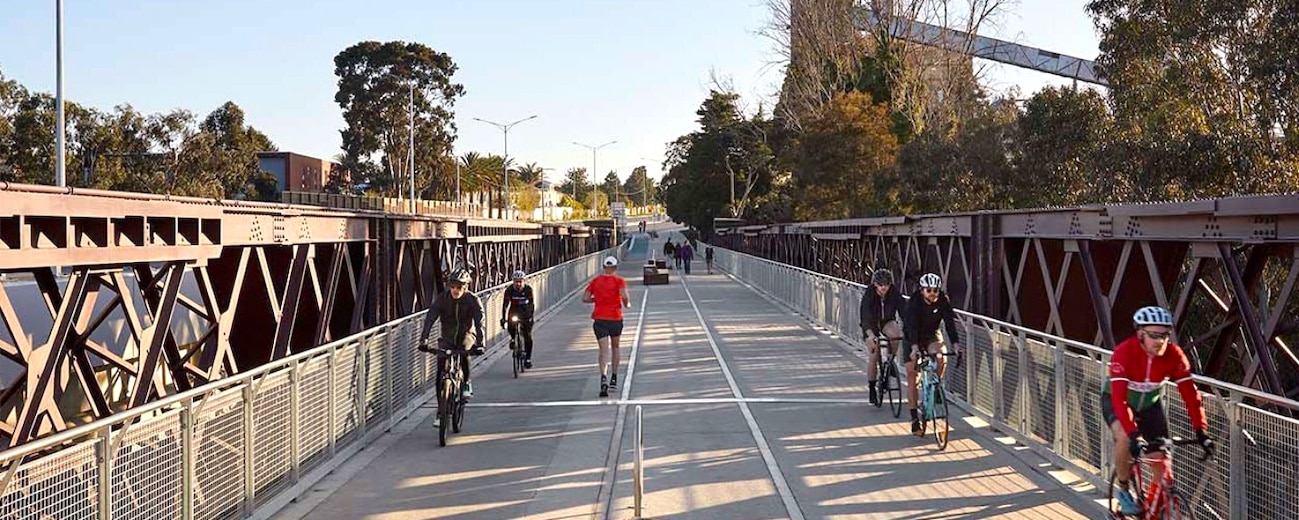
The new Victorian Active Transport Plan, which will guide the development of biking and walking across the state for the next decade, has been released.
It sets out to bring bike travel into a new era where there is increasing focus on planning our cities and regions for increased population, and most especially, the housing to accommodate it.
It envisages bike riding and walking to be at the centre of these new communities, denser than our older suburbs, and located in precincts clustered around public transport.
Bike plans and strategies are released periodically by governments, always with the aim of increasing the share of active transport and reducing dependence on motorised transport, with its negative impacts on health, climate and liveability.
The new document is different in one respect: it includes walking as well as bikes in the plan for the first time.
Notably it aims for a more unified approach than previously. It outlines “how the Victorian Government will partner with local government and other key stakeholders to improve coordination, get more people to make more trips by active transport, and boost liveability.”
The plan is based on five pillars:
- accessibility and inclusion (all Victorians have access to inclusive active transport options that meet the diverse needs of individuals and communities)
- places and neighbourhoods (well-designed places and neighbourhoods enable walking and riding that support local connectivity and enhance community liveability)
- integrated transport and safe street environments (to enable everyone to walk or ride for short everyday trips)
- health and wellbeing (by improving active transport networks, we will provide more opportunities for people to be physically active)
- climate response (Victoria is building climate-resilient places and networks that enable people to choose active transport to reduce emissions).
Bicycle Network, the nation’s leading active transport advocacy organisation, has welcomed the plan as recognising that bike and pedestrian facilities need to be at the centre of transport plans for the new high-density housing and economic precincts that are being developed in Melbourne and regional centres.
“The new communities that are being planned around public transport will be dense with people at street level, and they will be using bikes to get around locally and to make trips to the station,” Alison McCormack, Bicycle Network CEO, said following the release of the plan.
“The plan reflects our changing transport needs and places bike riding and walking at the same level as other transport modes.”
“The plan makes it clear that bike facilities are not an optional extra in the transport system, they are a core component of every decision we make when planning where we work and live.”
“And crucially, the new plan shows a pathway for the state government, its agencies and the state’s municipalities to work together to better coordinate investment in biking and walking facilities that will be attractive, safe and connected.”
Ms McCormack said as the plan did not list specific priorities, nor any timetables for delivery, she looked forward to the government quickly releasing more details of what will be coming down the pipeline in the next few years.
In the foreword to the document, Gabrielle Williams, the Minister for Transport Infrastructure and the Minister for Public and Active Transport, said that active transport was not just a convenience, it was essential.
She described the plan as a a “forward-looking strategy that sets out the actions we’ll take to build a state where walking and riding are not just possible but preferred”.
“This plan is our roadmap to achieving a bold target: 25 percent of all trips being active by 2030,” she said.
“It plays a critical role in delivering on our climate commitments and supporting broader priorities.
“Encouraging a shift to active transport is about more than just reducing emissions – it improves health, eases the cost of living, and reduces congestion on our roads.”

Or become our friend and subscribe to receive our fortnightly newsletter.