

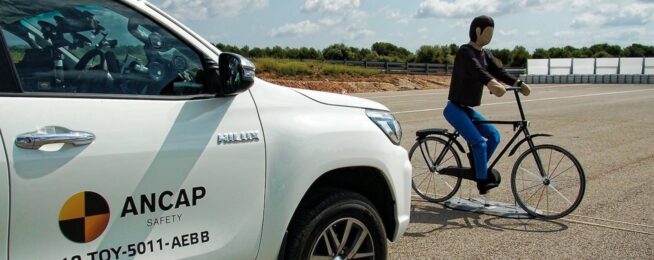
The federal government has proposed making autonomous emergency braking systems (AEBS) that detect people on bicycles and on foot compulsory for all new cars and light vehicles in Australia.
AEBS automatically detects an imminent forward collision and activates the vehicle braking system to slow the vehicle with the purpose of avoiding or reducing the impact of a collision.
Such systems are already mandated for car-on-car collisions but not those that have the ability to detect car-to-bicycle scenarios.
With driver distraction and inattention at plague levels, due mainly to illegal use of mobile phones by drivers, the move could significantly shift the balance of safety towards vulnerable road users.
Many crashes simply would not occur, or if they did, would be less likely to result in serious injury or death, if AEBS was deployed at scale in motor vehicles across the nation.
Some vehicles have the technology already fitted, and it has proved effective in use around the world.
The Australian government proposes to introduce it by adopting the international standard United Nations Regulation No. 152 (uniform provisions), thereby harmonising the Australian Design Rule with its international equivalent.
This simplifies and lessens the cost impact for manufacturers who can supply the same system in vehicles worldwide and in all Australian states.
The Department of Infrastructure and Transport says its data shows that there were on average 39 cyclist fatalities annually from 2018 to 2022, while in 2021, 8,163 riders were admitted to hospital resulting from road crashes in Australia.
It says the fitting of AEBS will reduce these numbers and lessen pressure on our hospital system.
The proposal is out for consultation until 27 November 2025 at 5pm (AEDT).
The department says government intervention is an essential tool when the market fails to provide the most efficient and effective solution to a problem.
"In the case of road safety, significant levels of road trauma remain in Australia.
“With recent developments in vehicle technology, mandating technologies that will provide substantial safety measures are necessary to achieve Vision Zero – that is, zero deaths and serious injuries on the roads by 2050.”
The department does not anticipate opposition from the motor vehicle sector as car-on-car AEBS is already mandated, while the system to detect bikes will be mandated in Europe from next year.
Or become our friend and subscribe to receive our fortnightly newsletter.