The Queensland government’s proposed e-mobility laws have been significantly watered down, with a parliamentary committee recommending the blanket 10km/h speed limit be scrapped in favour of a more targeted approach.
However licensing remains a key component of the proposed laws, despite widespread backlash from thousands of opponents.
The State Development, Infrastructure and Works Committee, the body that conducted the original inquiry into e-mobility safety and handed over 28 recommendations to Transport Minister Brent Mickelberg in March, tabled its report on Friday afternoon, May 8.
More than 3,000 public submissions were received, and committee Chair Jim McDonald thanked all stakeholders before recommending that the Bill be passed.
The committee has recommended that the 10km/h limit apply only in high pedestrian zones, with signposts defining where those areas begin and end.
On other footpaths, the committee has suggested a 10km/h limit only when a rider is within 10 metres of a pedestrian.
Critically, the committee recommended that the 10km/h limit not apply to shared paths, unless they are specifically signed. For shared paths, it has instead proposed a 15km/h limit when within 10 metres of a pedestrian.
Other major elements of the legislation have been given the green light.
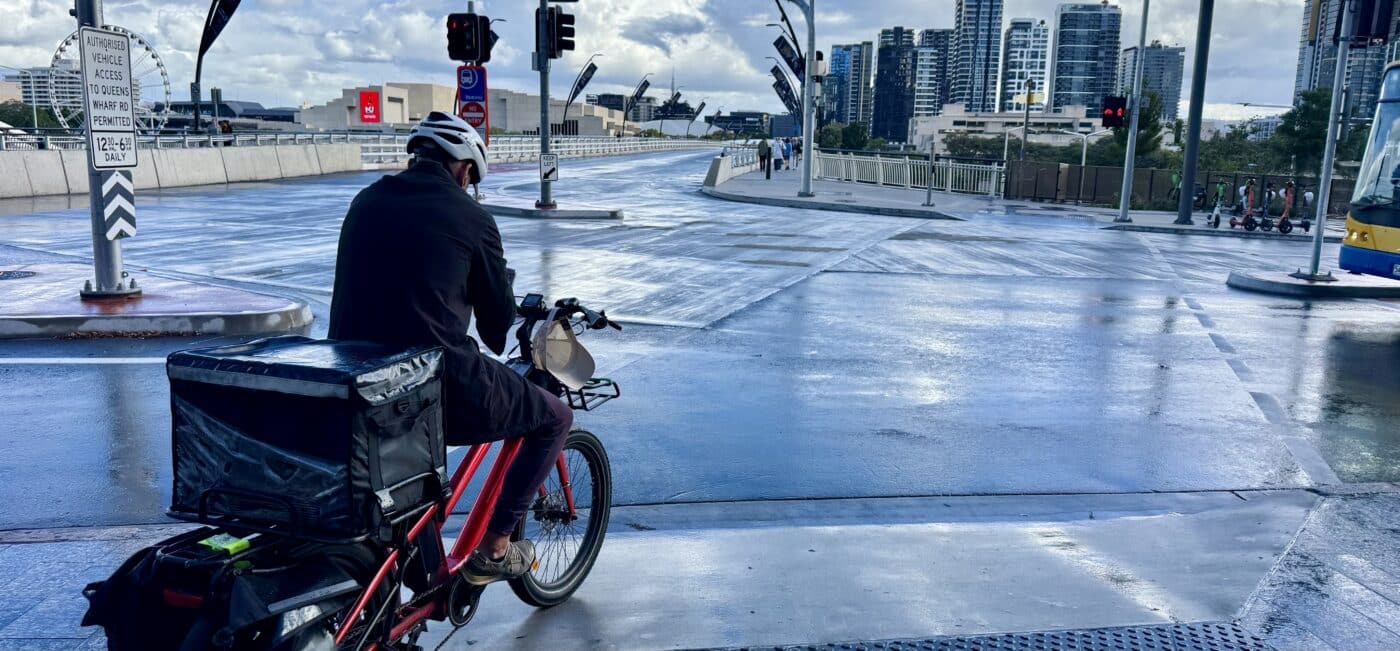
All riders - presumably including delivery riders and international visitors - will be required to hold at least a learner’s licence. Food delivery companies have previously stated that the proposed laws would affect many of their riders who rely on e-bikes because they do not have a motor vehicle licence.
But the committee has recommended licensing exemptions for the elderly and disabled, following submissions from disability advocates who warned that the bill would strip many people of their primary means of independent mobility.

Under 16s banned
Under-16s will be banned from riding e-bikes and e-scooters on public paths and roads, with parents and guardians liable to face penalties unless they can show they were unaware of the conduct.
Other measures in the bill remain intact, including new police powers to seize and destroy illegal e-mobility devices, random breath testing for riders, and stronger accountability for retailers and suppliers selling non-compliant devices.
In summary, the recommendations include:
* Amending the Bill to clarify that a compliant electrically power-assisted cycle (EPAC) is one that complies with the version of the EN 15194 standard that was in place when an EPAC was manufactured
* Providing enhanced exemption mechanisms for devices that cannot fully meetEN 15194 compliance standards, but meet key safety criteria - such as e-trikes, adaptive devices, and cargo bikes
* Introducing an assurance scheme that can certify and label currently compliant e-bikes, at minimal cost, rather than relying on the manufacturer
* Amending the Bill to provide an enhanced exemption framework from licensing requirements, so that individuals who cannot obtain a licence because of disability, a medical condition, or age, but are still capable of safety riding an e-mobility device, are able to do so
* Removing the uniform 10km/h speed limit from shared paths, in line with the committee's Report No. 21, and applying instead the 10km/h speed limit only to footpaths in high pedestrian areas
* Investigating the introduction of a mechanism that would enable e-mobility riders to use designated and controlled public access areas safely - such as rail trails, mountain bike parks, and other low-risk public access areas - with minimal restrictions
* Working with shared providers and hire companies to ensure compliance
* Undertake a review of the measures implemented after 12 months
With the government holding a majority, the legislation is expected to pass, with a six-month transition period following a commencement date of 1 July 2026.
More to come.