


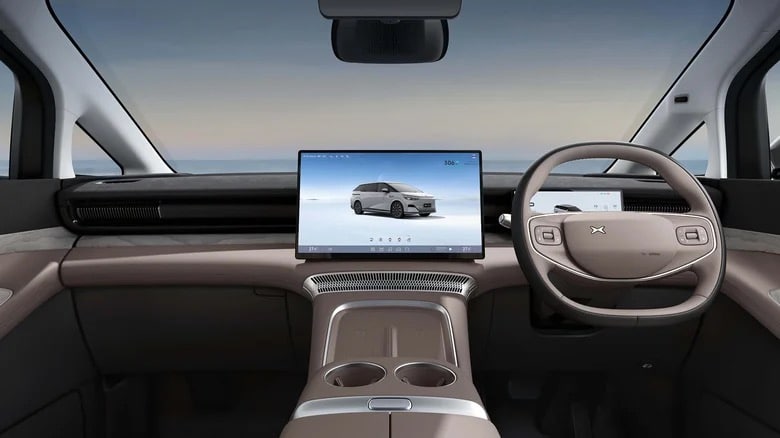
Sometime during the past decade of automotive evolution, the car dashboard morphed from switches, knobs and gauges into something more like a living room wall. Screens are everywhere; they seem an inescapable part of daily life these days, and that includes inside the car.
A classic example is this recent newspaper spread (pictured above) comparing three of the hottest utes on the Australian market right now. Like just about every new vehicle out there, the BYD Shark, Nissan Navara, and Kia Tasman feature dashboards dominated by a significantly sized screen.
We’re talking about immersive 12-inch multi-function screens that glow brightly and are an ever-tempting distraction for fingers, eyes, and attention.
This week, while in an Uber - a near-new SUV from the Chinese brand Cherry - it was almost as if the journey was being gamified. Entering a roundabout, the large centre screen suddenly changed from entertainment, vehicle, and tyre pressure status to a video-like bird’s-eye view of the car navigating said roundabout. Is this necessary? Why is it needed? Who asked for it? And which occupant of the car is the live view for? Surely - mid roundabout, when attention and focus are of paramount importance - not the driver?
It’s heartening to hear that ANCAP agree. As the nation’s independent voice on vehicle safety, ANCAP recently released a factsheet titled What’s New From 2026? Included in the wide-ranging update is a section that includes the following -
‘If you’ve noticed that some new cars have the most basic driver controls buried within touchscreens and sub-menus, you’re not alone.
It’s time to bring back buttons and stalks and remove some of the complication (and distraction!).
From 2026, we’re asking car makers to either offer physical buttons for important driver controls like the horn, indicators, hazard lights, windscreen wipers and headlights, or dedicate a fixed portion of the cabin display screen to these primary driving functions.’
It’s obvious that physical buttons have infinite advantages. Quickly learned by feel and muscle memory, adjusting the radio, air conditioning, or rear demister requires only a simple flick of a knob rather than navigating a sub-menu while focusing on the road ahead.
Human error has always been the leading cause of road crashes, with distraction ranking alongside speeding and fatigue as the biggest risks facing motorists and vulnerable road users alike.
The rapid rise of large infotainment screens and touch-controlled vehicle systems is adding a new layer to the problem. Numerous international studies have found that screen-based distraction can impair driver reaction times more severely than driving over the legal alcohol limit. The issue is not simply cognitive distraction, but visual distraction — the time a driver’s eyes are diverted away from the road ahead.
At 50km/h, taking your eyes off the road for just two seconds means blindly travelling around 27 metres. In urban environments, that distance can easily include an intersection, pedestrian crossing or a bike rider.
At the end of the day, no notification, playlist selection or augmented reality style overhead video is worth the lapse in concentration that could injure or kill another road user.