

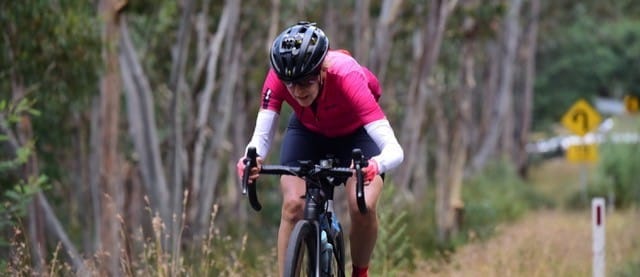
Riders who read rejoice: there's a fantastic new cycling memoir out.
Saskia Beudel's Peaking: One Hundred and Eleven Days on Two Wheels chronicles her journey training for Peaks Challenge.
An accomplished fiction and nonfiction writer, Beudel interweaves notes from her training with deep dives into the history and cultural resonances of riding itself, including the connection between cycling and the Suffragette movement. Delving into bike lore also brings Beudel in closer touch with her own Dutch ancestors — while mapping her ever-longer rides around Canberra brings her closer to the landscapes around her.
This genre-defying book also integrates black-and-white photographs taken on Beudel's rides, cataloguing the places — and creatures — she comes across while training.
The book culminates in a nail-biting description of Beudel's Peaks Challenge experience in 2022.
This book will be a captivating read for anyone who has trained for a major cycling event — or, indeed, any endurance sporting event. But it also has much to offer the general bike enthusiast, who will recognise the way riding brings you closer to your external environment, and will enjoy learning about the bike's cultural history.
Monash University Publishing have generously provided Bicycle Network with five copies of Peaking to give away. To go in the draw to win a copy, enter your details here.
We speak to Beudel about her book below.

What made you want to write this book?
I initially pitched the book to Duke University Press, who publish a series of short books called Practices, which are about people's amateur passions. The idea is to show how an ordinary everyday activity can be explored for a broad readership. I pitched a book about cycling, they expressed interest and that opened up the idea for me. Peaking is my fourth book, and I was curious about not only training for Peaks Challenge but also thinking about how to write about an activity like cycling.
My training notes gave me a lot of raw material but obviously nobody wants to read every single day of your training notes! So I had to work out what else could be included, how to pull it all together and create a structure. I wanted to think about the bike's cultural history and its history as a piece of technology. Researching these topics for the book was fascinating — for example, learning how important the bicycle was in the late nineteenth century for women, how it provided a whole new form of independent mobility. The bicycle also had a direct impact on women's fashion, freeing women from long skirts and corsets. There's a real irony in how liberating the bike was historically, given that in the twentieth and twenty-first centuries cycling has become such a male-dominated sport.
What parts of Peaks Challenge training did you really enjoy?
I loved getting to know my local landscapes better. I'm originally from Melbourne and moved to Canberra about twenty years ago. Originally I found the Canberra region a difficult place to get to know and appreciate. Being on the bike for many hours of Peaks training was a vivid way to engage with local landscapes. I explore environmental topics in my other books and essays, and landscape has been a big passion across my writing career. It was great to immerse myself in the local environment in the process of writing this book.
And what did you find especially challenging?
Finding enough hours in the week. Training for an event like Peaks is a huge time commitment, and having to balance training with paid work, writing time and parenting commitments was sometimes such a juggle! There were also physical challenges — because there's so much climbing in Peaks, I had to learn how to shift away from just commuter cycling, which I've always done — since the age of around 20. To tackle this much more demanding form of cycling — learning to go uphill or cover big distances — was definitely challenging. I have a clear memory of an experienced Peaks rider telling me I should complete at least two 180km rides with hills before doing the event. That became a real milestone and it took a lot of endurance training to build up to those big demanding rides.
To date you've completed Peaks Challenge just once, in 2022. Would you do it again?
Some cycling friends in Canberra have invited me to train again for next year and I'm entertaining it pretty seriously! But I also have lots of other commitments, so it depends. I am definitely drawn to giving it a final try.
Do you have any advice for someone training for Peaks?
I think the biggest thing I learnt was consistency — consistent training, learning how to extend your limits incrementally, not in a crazy way where you risk burnout or injury.
Also, a great piece of advice I received is to remember that the day itself will be full of ups and downs and your energy and mood will shift throughout the event. There will be moments where you feel super fit and strong and almost euphoric, and others where you're depleted and fatigue sets in. It's important to know during those low points that if you just keep going, it will shift again.
Peaking: One Hundred and Eleven Days on Two Wheels by Saskia Beudel, Monash University Publishing, 2026, RRP$32.99.
Or become our friend and subscribe to receive our fortnightly newsletter.